
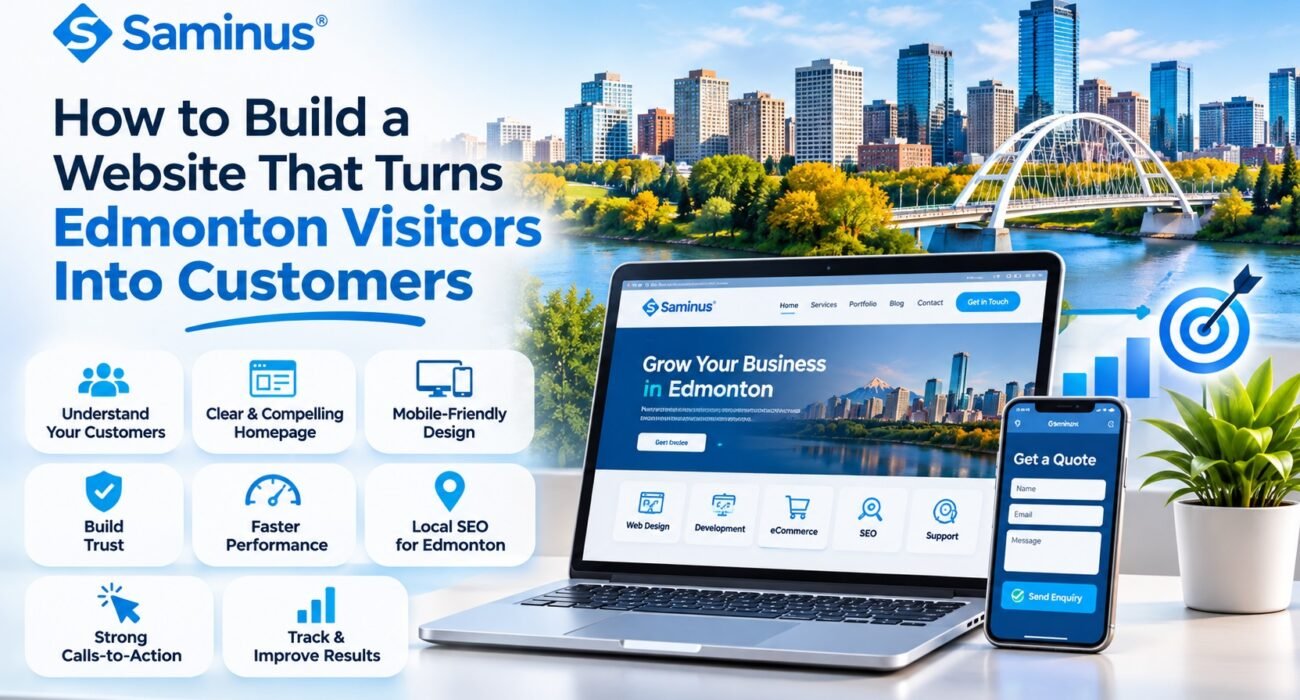
How to Build a Website That Turns Edmonton Visitors Into Customers
Why Your Website Should Do More Than Look Good
A professional website is often the first interaction a potential customer has with your business. But attracting visitors is only the beginning. The real objective is to turn those visitors into enquiries, appointments, and customers.
For businesses in Edmonton, a high-performing website should communicate value quickly, build trust, and make taking the next step simple.
Whether you operate a local service company, professional firm, retail business, or eCommerce store, your website should be designed around one important question:
What should a visitor do after landing on your website?
The answer should guide your design, content, navigation, and conversion strategy.
1. Understand Your Target Customers
Before designing your website, understand who you want to reach.
Consider:
- What services or products are customers looking for?
- What problems are they trying to solve?
- What questions do they ask before contacting a business?
- What makes them choose one provider over another?
- What information do they need before making a decision?
For Edmonton businesses, location-specific information can also help visitors understand whether your services are relevant to their area.
Build your website around real customer needs rather than simply listing everything your business offers.
2. Create a Clear and Compelling Homepage
Your homepage should explain three things almost immediately:
- What does your business offer?
- Who do you serve?
- Why should customers choose you?
Use a clear headline, a short supporting message, and a prominent call-to-action.
For example:
Headline: Professional Website Solutions for Growing Edmonton Businesses
Supporting text: Build a stronger online presence with modern website design, responsive development, and business-focused digital solutions.
Call-to-action: Get a Free Consultation
Avoid vague headlines that sound attractive but fail to explain what your business actually does.
3. Make Navigation Simple
Visitors should not have to search through multiple pages to find basic information.
A practical navigation structure may include:
- Home
- About Us
- Services
- Portfolio or Projects
- Blog
- Contact
For businesses offering multiple services, create dedicated service pages. This makes information easier to understand and gives search engines clearer context about each offering.
Keep menus organized and avoid unnecessary navigation options.
4. Design for Mobile Users First
Many customers discover businesses through smartphones. Your website should provide a smooth experience across mobile phones, tablets, and desktops.
Important mobile design practices include:
- Readable text without zooming.
- Buttons large enough to tap comfortably.
- Simple mobile navigation.
- Properly sized images.
- Fast-loading pages.
- Easy-to-use enquiry forms.
- Click-to-call and WhatsApp options where appropriate.
Responsive web design also supports Google’s mobile-first indexing approach, making mobile usability an important consideration for search visibility.
5. Build Trust Through Website Content
Visitors are more likely to contact a business when they understand its expertise and feel confident about its services.
Include useful trust-building elements such as:
About Your Business: Explain your experience, approach, and areas of expertise.
Services: Describe what you offer, who it helps, and what customers can expect.
Portfolio: Display genuine projects and relevant examples of your work.
Testimonials: Share authentic customer feedback with permission.
Contact Information: Make your business phone number, email, location, and enquiry options easy to find.
Avoid unsupported claims, fabricated reviews, or generic statements that do not demonstrate real value.
6. Write Content That Encourages Action
Website content should answer customer questions and guide visitors towards a decision.
Instead of using generic statements such as “We provide the best services”, explain what makes your solution useful.
For example:
- Describe the problem your service solves.
- Explain how your process works.
- Highlight relevant features and benefits.
- Address common customer concerns.
- Include a clear next step.
Use short paragraphs, descriptive headings, bullet points, and straightforward language.
Every important page should help visitors understand what to do next.
7. Add Strong Calls-to-Action
A call-to-action (CTA) tells visitors what action to take.
Useful examples include:
- Request a Quote
- Book a Consultation
- Call Our Team
- Get Started
- Send an Enquiry
- Shop Now
Place CTAs where they make sense, such as the homepage, service pages, product pages, and contact section.
For local service businesses, click-to-call and WhatsApp buttons can make enquiries more convenient.
Avoid placing too many competing buttons on the same page. Focus on the most important action.
8. Improve Website Loading Speed
A visually attractive website can still lose potential customers if pages take too long to load.
Improve performance by:
- Compressing and resizing images.
- Using modern image formats such as WebP.
- Enabling suitable caching.
- Reducing unnecessary scripts and plugins.
- Optimizing CSS and JavaScript.
- Choosing reliable hosting.
- Monitoring Core Web Vitals.
Google recommends aiming for these Core Web Vitals targets:
- LCP: 2.5 seconds or less.
- INP: 200 milliseconds or less.
- CLS: 0.1 or less.
These measurements help assess loading performance, responsiveness, and visual stability. Good scores support user experience but do not guarantee search rankings.
9. Optimize Your Website for Local SEO in Edmonton
A website should help relevant local customers discover your business.
For Edmonton businesses, local SEO can include:
- Creating dedicated pages for important services.
- Using Edmonton naturally in relevant page titles and content.
- Maintaining accurate business contact information.
- Optimizing your Google Business Profile.
- Collecting genuine customer reviews.
- Publishing useful local content.
- Adding appropriate LocalBusiness structured data.
If you serve nearby communities, mention them only where your business genuinely provides services. Avoid creating repetitive location pages with little useful information.
10. Make Contact and Enquiry Forms Easy
A complicated contact process can discourage potential customers.
Keep enquiry forms simple and request only the information you genuinely need.
A typical form may include:
- Name
- Email or phone number
- Service required
- Brief message
Also consider displaying your business contact details and expected response process.
For eCommerce websites, simplify checkout, clearly display delivery information, and provide accessible customer support options.
11. Measure What Happens After Visitors Arrive
Website development should not stop at launch. Performance should be reviewed using real visitor behaviour.
Useful tools include:
- Google Analytics 4 for website traffic and conversion events.
- Google Search Console for search visibility and indexing.
- Google PageSpeed Insights for performance testing.
- Heatmap tools for understanding visitor interactions.
Track meaningful actions such as phone clicks, enquiry submissions, appointment bookings, and purchases.
Use this information to identify pages that attract visitors but generate few enquiries. Small improvements to content, navigation, or CTAs can make the customer journey more effective.
Why Choose Saminus for Website Development?
Saminus Private Limited helps businesses build a professional digital presence through website design, development, and technology solutions.
Our approach focuses on combining modern design with practical functionality and a user experience that supports business objectives.
Our services include:
- Business and corporate website development.
- Custom website design and development.
- WordPress website development.
- eCommerce website development.
- Responsive web design.
- Website redesign and optimization.
- SEO-friendly website structure.
- Custom web applications.
Whether your business needs a new website or wants to improve an existing one, Saminus can help you plan a solution around your requirements.
Turn Your Website Into a Business Growth Tool
A successful business website does more than attract traffic. It helps visitors understand your value, builds confidence, and makes contacting your business easy.
For Edmonton businesses, investing in thoughtful website design, useful content, mobile performance, and conversion-focused development can create a stronger digital customer journey.
Ready to build a website that works for your business?
Connect with Saminus Private Limited to discuss your website development requirements.
Website: https://saminus.com/
Phone: 7015968927